Grounding in Massage Therapy | New Age Bodywork
What Is Grounding, and Why Does It Matter in the Massage Room?
Have you ever arrived at a massage appointment and realized that, although your body is physically there, your mind is somewhere else entirely? Maybe you're thinking about the work you left unfinished, the conversation you had earlier that morning, or the growing list of things waiting for you when you leave. You're lying on the table, hoping to relax, but your mind hasn't quite caught up with your body.
I think we've all experienced some version of this. We spend so much of our lives moving from one responsibility to the next that we sometimes forget what it feels like to simply be where we are.
This is where grounding comes in.
Grounding is the practice of bringing our awareness back to the present moment. It is an opportunity to reconnect with our surroundings, our senses, and the experience of being in our bodies. It doesn't necessarily mean feeling calm, relaxed, or peaceful. Rather, it means becoming aware of what is happening right here, right now, without immediately needing to change it.
In my massage practice, grounding is an important part of the work I do. Not just for my clients, but for myself as the practitioner. Because when we begin to understand the relationship between attention, our bodies, and our nervous systems, we begin to recognize that the quality of our presence can be just as important as the techniques we use.
What Does It Actually Mean to Be Grounded?
Our nervous systems are constantly gathering information about the world around us and the world within us. Even when we aren't consciously paying attention, our brains are processing sensations, interpreting experiences, and helping us respond to our environment.
Two important parts of this process are proprioception and interoception.
Proprioception is our body's ability to sense its position and movement in space. It's how you can close your eyes and still know where your hands are. It helps you recognize the support of the chair beneath you, the position of your shoulders, or the feeling of your feet pressing into the floor.
Interoception, on the other hand, is our ability to notice sensations happening inside the body. This might include recognizing our heartbeat, noticing hunger, sensing the movement of our breath, or becoming aware of tension in our abdomen.
Both of these sensory systems help us understand our experience of being in our bodies.
When we practice grounding, we can intentionally direct our attention toward some of this sensory information. We might notice the weight of our body against the massage table, the temperature of the room, or the gentle movement of our chest as we breathe.
These observations give our attention something tangible to return to when our thoughts begin wandering toward the past or future.
And there's something important I want to emphasize here: grounding is not about forcing ourselves to relax.
Sometimes, when we become more aware of our bodies, we discover that we're uncomfortable, anxious, restless, or holding tension we hadn't noticed before. That doesn't mean we're doing anything wrong. Grounding simply creates an opportunity to observe what is happening with a little more curiosity and a little less judgment.
For some people, focusing inward can even feel overwhelming. In those moments, noticing something outside the body, such as the room, a familiar sound, or the support beneath our feet, may feel more comfortable.
The goal isn't to achieve a particular feeling. It's to develop a more compassionate relationship with whatever we're experiencing.
Why Grounding Matters for Me as Your Massage Therapist
When I talk about grounding in massage, I think it's important to acknowledge that this responsibility doesn't belong entirely to the person receiving the massage.
It begins with me.
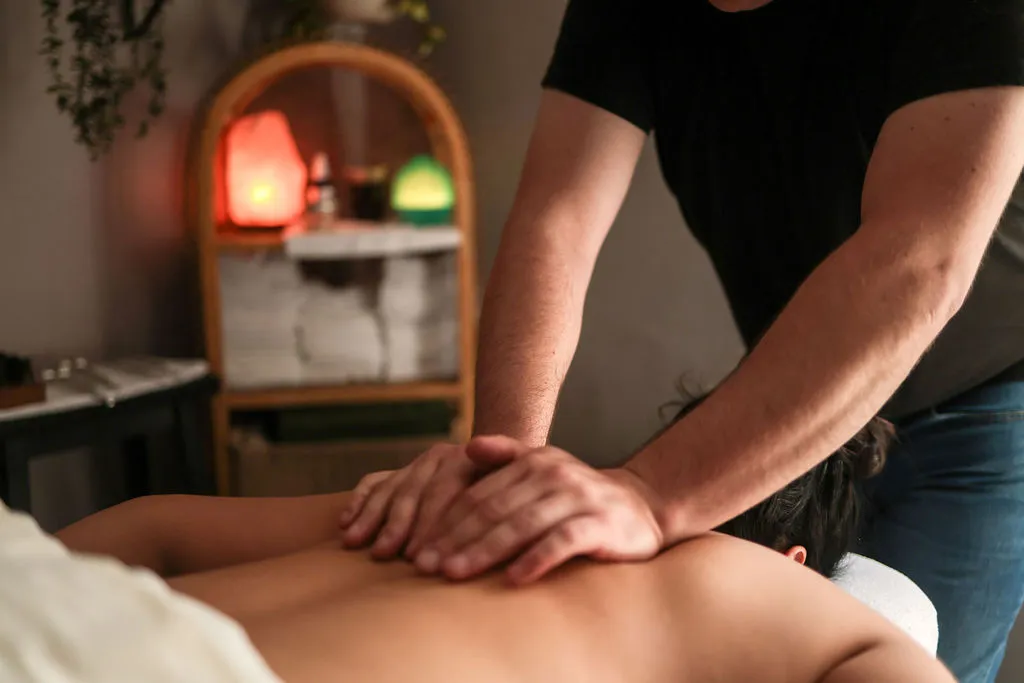
As a massage therapist, my job involves much more than identifying tight muscles and applying pressure. I'm also paying attention to how your body responds to touch, how your breathing changes, whether your muscles seem to resist or welcome a particular technique, and how comfortable you appear throughout the session.
To notice these things, I need to be present.
If I'm mentally rushing through my schedule, thinking about the next appointment, or becoming overly focused on making a particular muscle release, I may miss some of the subtle information your body is communicating.
This is why I practice grounding myself before and throughout our sessions.
Sometimes that means noticing my feet against the floor, becoming aware of my own breathing, or checking whether I'm holding unnecessary tension in my shoulders or hands. These small moments help me return my attention to the work happening directly in front of me.
They also remind me that I don't need to force your body to do anything.
When I'm grounded, I'm better able to approach each session with patience, curiosity, and intention. Rather than deciding what your body needs based entirely on what I feel beneath my hands, I can slow down, observe your responses, and invite you into the process.
I often think of this as the difference between working on someone and working with someone.
My presence doesn't automatically regulate your nervous system, and I can't determine how safe or relaxed you feel simply by observing your muscles. But I can contribute to a treatment environment that is predictable, attentive, and responsive to your needs.
And I believe that matters.
Why Grounding Matters for You on the Massage Table
Now, let's consider what grounding might look like from your perspective.
Many of my clients come to massage because they're experiencing chronic tension, persistent pain, or the feeling that their bodies are always working a little harder than they should.
Maybe your shoulders seem permanently attached to your ears. Maybe your jaw is clenched without you realizing it. Maybe you find yourself holding your breath during stressful moments, only noticing when you finally exhale.
These patterns can become so familiar that we stop consciously recognizing them.
Grounding gives us an opportunity to become curious about those patterns.
When you first settle onto the massage table, I might invite you to notice the support beneath your body. Can you feel where your shoulders make contact with the table? What about your hips? Do you notice a difference between your left and right sides?
There isn't a correct answer.
We're simply gathering information.
As the session continues, you might begin noticing how different types of touch feel. Perhaps a slow, sustained hold feels comforting, while deeper pressure makes you instinctively brace. Maybe your breathing becomes easier when we work around your ribs, or you notice that your hands have been clenched even though we're working on your back.
These observations can help us make decisions together about what feels useful and appropriate for your body.
Grounding may also help interrupt the habit of treating discomfort as something we must immediately fight against. Instead of asking, "How do I make this tension go away?" we might begin by asking, "What am I noticing right now?"
That shift from trying to control an experience toward observing it can be meaningful.
It doesn't mean pain or tension will disappear simply because we pay attention to it. Chronic pain is complex, and our bodies are influenced by many different physical, psychological, and environmental factors. But developing awareness can give us more information about our experiences and more opportunities to respond intentionally.
And importantly, you don't have to spend your entire massage concentrating on every sensation.
Sometimes the most supportive thing you can do is rest, daydream, or even fall asleep. Grounding is a tool available to you, not another responsibility you need to perform correctly.
Creating a Shared Experience of Presence
One of the things I appreciate most about massage is that it creates an opportunity for two people to slow down and pay attention to something together.
As the practitioner, I'm observing the quality of the tissue beneath my hands, the pace of my movements, and the feedback you're offering. As the client, you have access to an entirely different perspective: the sensations, emotions, preferences, and experiences happening within your own body.
Neither perspective tells the whole story on its own.
When we bring them together, massage becomes a conversation rather than something being done to you.
This is especially important in my approach to bodywork. I don't believe that more pressure, more intensity, or more effort automatically produces better results. Sometimes slowing down and allowing ourselves to notice what is happening provides more useful information than immediately trying to change it.
Grounding helps create space for that curiosity.
It also supports something I consider essential to meaningful bodywork: your autonomy. You are always welcome to ask for a change in pressure, request a different position, talk about what you're experiencing, or decide that a particular technique isn't right for you.
Your experience matters, and your feedback helps guide the session.
We aren't trying to achieve a perfect state of relaxation. We're creating an environment where your body can be approached with attention, respect, and compassion.
Bringing Grounding Into Your Everyday Life
The beautiful thing about grounding is that it doesn't require a massage table, a quiet room, or an hour of uninterrupted time.
You can practice it almost anywhere.
The next time you're feeling overwhelmed or disconnected, try noticing where your body makes contact with the world around you. Feel your feet inside your shoes. Notice the support of the chair beneath you. Look around and identify a few objects in your environment.
Then, if it feels comfortable, gently turn your attention inward.
What do you notice about your breathing? Are your shoulders lifted? Is your jaw resting comfortably? Are your hands relaxed, or are they gripping something?
You don't need to correct any of these things immediately.
Just notice.
Perhaps you'll discover that you want to change your position, take a slower breath, stretch, or simply give yourself a moment before moving on to the next task.
Over time, these little moments of awareness may help you recognize your needs earlier and respond to them with greater intention.
And that, to me, is one of the most valuable things we can take away from massage.
Not simply an hour or two of relief, but a growing ability to listen to our bodies with calm, compassionate curiosity.
At New Age Bodywork in Millcreek, Utah, I approach therapeutic massage as a partnership between practitioner and client. Through slow, intentional touch, thoughtful communication, and somatic awareness, my goal is to create space for you to explore your body's experiences without pressure to force change.
Because sometimes the first step toward feeling different is simply allowing ourselves to notice how we feel right now.
Curious about experiencing a different approach to massage? Learn more about somatic bodywork and how we can work together to support your relationship with your body.